

Location: Romblon Island
Depth: medium depth / deeper water
Cover Photo: Michael Höhl
Scientific Name: Hippocampus denise, Lourie & Randall, 2003
Type: Romblon Fish
Group: Pygmy Seahorses | Seahorses
Family: Syngnathidae


Hippocampus denise: The Legendary Denise’s Pygmy Seahorse
Hippocampus denise, known as Denise’s Pygmy Seahorse, represents one of the most extraordinary and sought-after rare marine animals found in Philippine waters. This microscopic marvel has achieved legendary status among underwater macro photography enthusiasts and scuba diving professionals exploring the pristine coral reefs surrounding Romblon Island, where encounters with this elusive species rank among the most prized discoveries in Indo-Pacific diving.
A Species of Mythical Proportions
The scientific name Hippocampus denise honors renowned marine biologist Dr. Denise Tackett, reflecting the species’ importance in advancing our understanding of rare critters in Philippine marine ecosystems. This extraordinary seahorse embodies the hidden treasures that await discovery around Romblon Island, representing the kind of remarkable encounters that establish world-class diving destinations and attract dedicated marine life enthusiasts from across the globe.
Distinctive Features and Identification
Hippocampus denise measures around16 millimeters in length, making it one of the smallest seahorse species on Earth and an ultimate challenge for underwater macro photography specialists. The species displays incredible morphological adaptations, including skin tubercles and coloration patterns that perfectly match their gorgonian coral hosts.
The Denise’s Pygmy Seahorse demonstrates remarkable camouflage abilities, becoming virtually invisible against sea fan corals where they live their entire lives. Hippocampus denise exhibits classic seahorse reproductive behavior, with males carrying developing eggs in specialized brood pouches, though observing this behavior requires exceptional patience and advanced macro photography techniques. They look similar to the Bargibanti Pygmy Seahorse (Hippocampus bargibanti), but have unique features.
Habitat and Distribution in Romblon Island Waters
Hippocampus denise inhabits specific gorgonian coral species throughout Romblon Island’s marine areas, typically found on sea fans in depths ranging from coral gardens at medium depth to deeper reef slopes. The species demonstrates absolute host specificity, making successful encounters dependent on locating healthy gorgonian coral populations.
Scuba diving photographers pursuing underwater macro photography documentation will find Hippocampus denise represents the ultimate test of skill and persistence. Their small size and perfect camouflage create photography challenges that separate novice enthusiasts from expert practitioners, while Romblon Island’s exceptional water clarity provides the optimal conditions necessary for capturing detailed images of these rare marine animals.
Fascinating Behavioral Trivia and Adaptations
One of the most remarkable aspects of Hippocampus denise is their lifelong monogamous partnerships, with pairs remaining together on individual coral colonies for their entire existence. These tiny seahorses demonstrate complex courtship rituals that involve intricate dances and color changes, behaviors that are rarely witnessed due to their microscopic scale.
The species exhibits extraordinary site fidelity, often remaining within a few centimeters of their birth location throughout their lives. Hippocampus denise feeds exclusively on minute planktonic organisms, utilizing their tubular snouts to create powerful suction that captures prey smaller than the period at the end of this sentence.
Significance for Marine Research and Conservation
The presence of Hippocampus denise around Romblon Island indicates exceptionally healthy coral reef ecosystems, as these rare critters require pristine water conditions and thriving gorgonian coral populations to survive. Their existence serves as a biological indicator of marine ecosystem health and the effectiveness of local conservation efforts.
Underwater macro photography documentation and scuba diving observations of the Denise Pygmy Seahorse, Hippocampus denise contribute crucial data to seahorse conservation research and rare marine animals distribution studies. These encounters emphasize the importance of protecting Romblon Island’s marine sanctuaries, which serve as critical habitats for some of the world’s most specialized and vulnerable marine species.
Perfect Conditions for Underwater Macro Photography
The coral reef environments surrounding Romblon Island provide world-class conditions for documenting Hippocampus denise and other rare critters that inhabit these pristine Philippine waters. The region’s superior water transparency, healthy gorgonian coral populations, and minimal current disturbance create ideal scenarios for advanced underwater macro photography techniques.
Professional underwater macro photography specialists and dedicated scuba diving enthusiasts will find Romblon Island’s reputation for rare marine animals encounters well-deserved, with Hippocampus denise (Denise Pygmy Seahorse) representing one of the pinnacle achievement among the diverse community of rare critters that thrive in these exceptional Philippine coral reef ecosystems.
Denise’s pygmy seahorse is a beautiful fish species. It is also called Yellow Pygmy Seahorse – although it can be found in several colors in Romblon, like apricot, yellow, rose, red and red with white marks (nicknamed Santa Claus Pygmy Seahorse). It can live on different types of Gorgonian fan coral species, unlike a Bargibanti Pygmy Seahorse, which always lives on the same species of Gorgonia. Hippocampus denise gets its ultimate color and body texture after finally choosing its sea fan to spend its whole adult life on. Denise’s pygmy seahorse can reach a maximum length of approximately 2.4 cm.
Just like the Bargibant’s pygmy seahorse, Denise’s Pygmy Seahorses are very fragile and sensitive to light. Please take special caution when taking photos of this tiny fish.
Related posts:
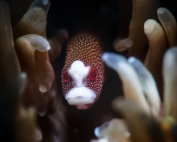 Bulbonaricus brauni | Braun’s Pughead Pipefish
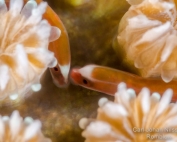 Bulbonaricus brucei | Bruce’s Pughead Pipefish
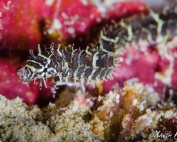 Halicampus nitidus | Glittering Pipefish
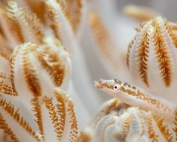 Siokunichthys herrei | Spotted Xenia-Pipefish
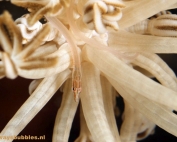 Siokunichthys bentuviai | Barred Xenia-Pipefish
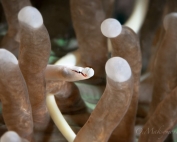 Siokunichthys nigrolineatus | Mushroom-Coral Pipefish
 Kyonemichthys rumengani | Lembeh Seadragon
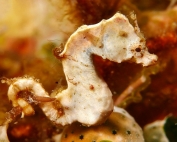 Hippocampus pontohi | Pontohi Pygmy Seahorse
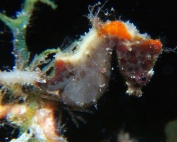 Dark Hippocampus pontohi | Severnsi Pygmy Seahorse
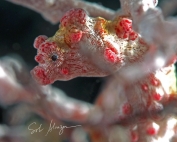 Hippocampus bargibanti | Bargibanti Pygmy Seahorse
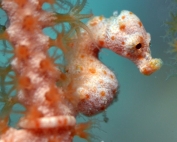 Hippocampus denise | Spotted Denise’s Pygmy Seahorse
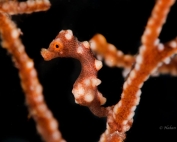 Hippocampus denise | ‘Santa Claus’ Denise Pygmy Seahorse